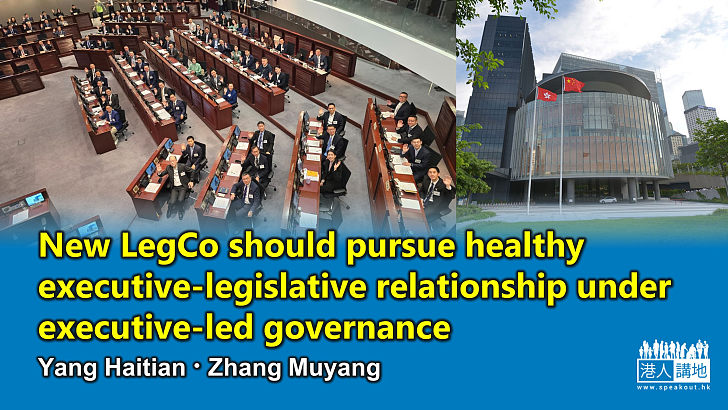
Hong Kong has just successfully completed its 8th Legislative Council (LegCo) election. In congratulating the newly elected legislators, the Hong Kong and Macao Affairs Office of the State Council expressed hopes that they would “consciously uphold the executive-led system and correctly handle the executive-legislative relationship.” What exactly does this mean for the 90 legislators who will be sworn into office by the end of the year? How should they perform their duties accordingly? Now is a good time to take a closer look.
First, what is an executive-led system? The Basic Law, Hong Kong’s constitutional document, does not explicitly define the term, yet its essence can be inferred from Chapter IV on the political structure. Fundamentally, the “executive” in “executive-led” refers to the leading role of Chief Executive, as well as the dominant status that executive authorities have over the legislative authorities. Under the Basic Law, the Chief Executive (CE) is not only the head of the SAR government but, more importantly, the head of the entire SAR. This “dual identity” places the CE above the city’s legislative and judicial branches in the political hierarchy, as demonstrated by the CE’s power to dissolve the LegCo under specific circumstances and to appoint all judges. At the same time, the SAR government also enjoys dominant status in executive-legislative relationship reflected in its exclusive power to introduce bills related to public expenditure, political structure, or government operations, while legislators require formal consent from the CE to introduce bills concerning government policy. These institutional arrangements form the basis of the executive-led system.
What is the rationale behind this executive-led system? The answer lies in Hong Kong’s status as a Special Administrative Region (SAR) within China’s unitary state structure. In a unitary state, sovereign power resides solely with the central government, unlike federal systems—such as the United States—where sovereignty is shared between the national and constituent governments. As a result, all local governments in China, even highly autonomous ones like Hong Kong, must have a single authority capable of answering to Beijing on behalf of the entire region. This ensures national unity and enhances administrative efficiency in a country as vast and diverse as China. For Hong Kong, the system also supports the efficient administration and political stability essential for the proper functioning of an international financial and commercial center. Historically, the executive-led system adopted after Hong Kong’s return to China is also built upon previous political system with proved effectiveness under British colonial rule.
For the executive-led system to function properly, a healthy executive-legislative relationship is critical. Poorly managed relations between the executive and the legislature can lead to political instability—or 4worse. Two recent events stand out: earlier this year, Taiwan’s Democratic Progressive Party backed an ill-fated mass recall campaign targeting opposition lawmakers who, with their majority in the Legislative Yuan, challenged the DPP-led government, resulting in months of bitter political confrontation and further social division. In the United States, the federal government experienced the longest shutdown in its history in October after Congress failed to pass appropriations legislation for the 2026 fiscal year, causing widespread disruption to government operations. Both cases illustrate how toxic executive-legislative dynamics, driven by partisan politics, can impede effective governance and harm the public interest.
This is precisely the scenario Hong Kong’s new legislators must avoid, and many emphasized this point during the election campaign, pledging to support the SAR government in various areas. Hong Kong has in the past suffered from legislative paralysis when opposition lawmakers abused filibusters to obstruct the LegCo and push 5anti-China and separatist agendas. Fortunately, the overhaul of the electoral system in 2021 ensured that only patriots could serve in the LegCo, laying the foundation for a healthy executive-legislative relationship. Subsequently, governance efficiency was improved: the 7th LegCo passed 130 bills—60 percent more than its predecessor—addressing complex issues such as ride-hailing services and the regulation of basic housing units.
However, a healthy executive-legislative relationship cannot be a matter of blind, one-sided obedience. During his 2022 visit to Hong Kong, President Xi Jinping emphasized that the executive and legislative authorities should both check and balance each other while also offering mutual support. This calls for the development of constructive legislative oversight, where the LegCo shares common policy objectives with the SAR government while providing advice and supervision to ensure proper policy implementation, as governance without legislative scrutiny is susceptible to corruption and bureaucratism.
Different policy issues require different approaches. On fundamental matters such as safeguarding national security, legislators must firmly uphold the bottom line and offer unwavering support for the government—as legislators of the 7th LegCo demonstrated by voting unanimously in favor of the Safeguarding National Security Bill. On issues related to Hong Kong’s development and reform, especially those closely associated with people’s livelihoods, legislators should diligently offer practical advice based on rigorous research that reflects public opinion. On issues involving evident misconduct or corruption, legislators should not hesitate to exercise their supervisory power.
The LegCo can also benefit from more drive and initiative. Instead of passively waiting for the government to introduce bills, legislators should use their wits and resources to help lay the groundwork by conducting polls and research, providing the government with better insight into the plausibility and potential risks of proposed policies. After a bill is passed, legislators should also assist the government in keeping the public fully informed about policy changes and collecting feedback. Rather than raising concerns and causing backlashes after a bill is introduced and debated, they should actively work with the government to improve the bill beforehand.
Legislators should also keep a close watch on how the government spends funds approved by the LegCo. Hong Kong is in need of greater fiscal scrutiny in the face of an increasing deficit. Regular legislative reviews should be applied to major public projects, with those that fail to produce satisfactory results facing suspension and adjustment to ensure funding is not misused.
As legislators are more flexible than government officials when partaking in public events and engaging with the general public, they should also be encouraged to explore more diverse channels to communicate with all sectors of Hong Kong society to improve public awareness and build consensus on key policy issues.
This constructive mode of executive-legislative interaction differs significantly from the model often seen in Western countries, where opposition politicians use the legislature to obstruct the ruling government at every turn, regardless of the consequences. Both the central government and the people of Hong Kong have high expectations for the new legislators, who must work diligently and swiftly to address the city’s many challenges and seize opportunities. By building on and expanding the effective practices of the 7th LegCo, the new legislature may help pioneer a new governance model—one that not only benefits Hong Kong but also offers an example for the world.
請Follow我們的YouTube頻道:https://bit.ly/2kgU8qg
下載我們的手機應用程式,收看第一手精彩內容:https://www.speakout.hk/app
















評論